At approximately 6:40 this morning, I found myself at Faro Airport using disability assistance to gain a tactical advantage in an overhead-locker war on an easyJet flight to Gatwick.
I had booked Club Europe.
I love my job.
Perhaps I should explain how we got here.
Technically, this story begins with a perfectly sensible two-day site visit to Portugal ahead of the World Sailing Inclusion Championships. In reality, it probably begins a week earlier in Bangalore, where our travelling circus had already provided fairly compelling evidence that international sport and commercial aviation are no longer compatible.
One member of the team was drinking god knows what on an airport floor. My assistant, Leo, was considerably less fortunate and suffered a gastrointestinal incident which, in the interests of international diplomacy and his remaining dignity, we will leave largely undocumented. This eventually earned him a visit to tropical diseases on his return to the UK, so perhaps we should acknowledge that he had objectively the worse week.
Stoggs was subsequently abandoned in Bangalore for approximately two days after his aircraft was damaged, because apparently even aeroplanes have started refusing to participate in our programme.
That should have been a warning. It wasn’t. There was another event to deliver.
There is always another event to deliver.
We may have created a monster
The reason for this particular expedition was the World Sailing Inclusion Championships in Portimão, which are now close enough that phrases such as “we’ll sort that later” cause me to develop a slight twitch.
WSIC started as an idea. Then it became an event. Then more nations came, more sailors came and more disciplines came. Development programmes started feeding sailors into it. Classification grew around it. Vision Impaired sailing joined the party. Intellectual Impairment grew. Para Wing appeared. Inclusive racing developed. More countries discovered it. More sailors wanted to come.
And everybody needed boats.
Somewhere during that process, the small creature we had been lovingly feeding after midnight became a fully grown international championship standing at the gates of Portimão demanding charter equipment, race officials, classifiers, accessible facilities, transport, insurance, measurement, medals, volunteers, coach boats and an apparently infinite supply of Hansa 303s.
WSIC is a monster.
I say that with enormous affection, because it is our monster. We built it, and I am incredibly proud of what it has become. But there comes a point in the life of every monster when you have to stop admiring how much it has grown and start checking whether anyone has reinforced the cage.
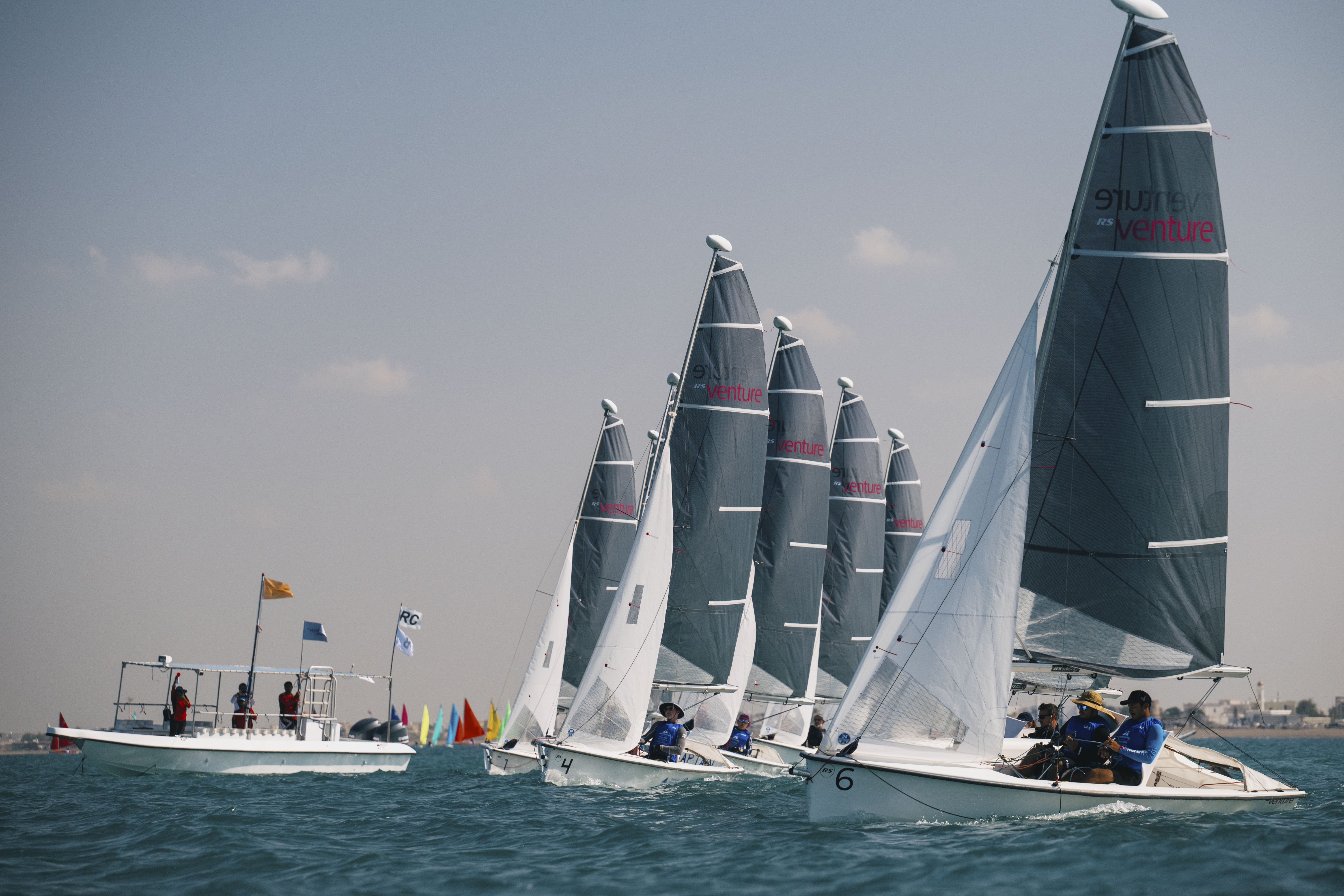
Hence Portugal.
The site visit was partly about making sure everyone really understands what is now coming. This isn’t a local regatta with some extra flags, and it isn’t even a conventional World Championship. We have sailors with physical impairments, vision impairment, intellectual impairment and cognitive impairment. We have multiple fleets, multiple racing formats, classification, development activity, international officials, equipment arriving from different countries, accessible accommodation and transport requirements, ceremonies, media, measurement, charter equipment and all the ordinary machinery of a major international event underneath it.
And then there are the boats.
Oh, the boats.
The Hansa 303 fleet has now reached the fascinating mathematical position where 56 entries exist, 35 require charter boats and approximately 14 charter boats are currently available.
Even with my limited mathematical qualifications, I have identified a small issue here.
My inbox has consequently become a maritime emergency department. Where is my boat? Do I have a boat? Who has my boat? Can I bring a boat? Can someone else use this boat? What is insured on the boat? Who is insuring the boat? When does the boat arrive? Where is the container? How big is the container? How long does the boat take to rig?
I am expecting somebody to ask shortly whether the boat has completed its athlete consent form.
For months, a great deal of this has inevitably landed with World Sailing while the championship has been taking shape. But we have now reached the exciting stage of event organisation where the host gets to experience the traditional hosting activity known as hosting the event.
Because the monster is no longer theoretical. It is coming. Rapidly.
There is a genuinely brilliant championship underneath all of this. The entries are fantastic. Sailors who first encountered our programmes through development activity are now preparing to compete at a World Championship. Countries are returning. New countries are entering. New disciplines are being tested. Classification work is progressing. Athletes who had very few meaningful international opportunities only a few years ago now have somewhere they want to be.
That is the whole point.
But growth creates a slightly inconvenient requirement: delivery has to grow with it. An event of this size cannot be run reactively, one email and one crisis at a time. There are now too many sailors, too many nations and too many moving pieces. Decisions have to happen quickly, responsibilities have to be clear and problems need solving before another twenty people discover the same problem independently.
In other words, the monster needs feeding.
We left the site visit with a considerably clearer picture of what needs to happen. Stoggs and I had walked the venue, talked through operations, interrogated logistics, identified problems, solved some problems and produced a healthy collection of new problems for everybody to enjoy.
All we had to do now was go home.
This was where we became overconfident.
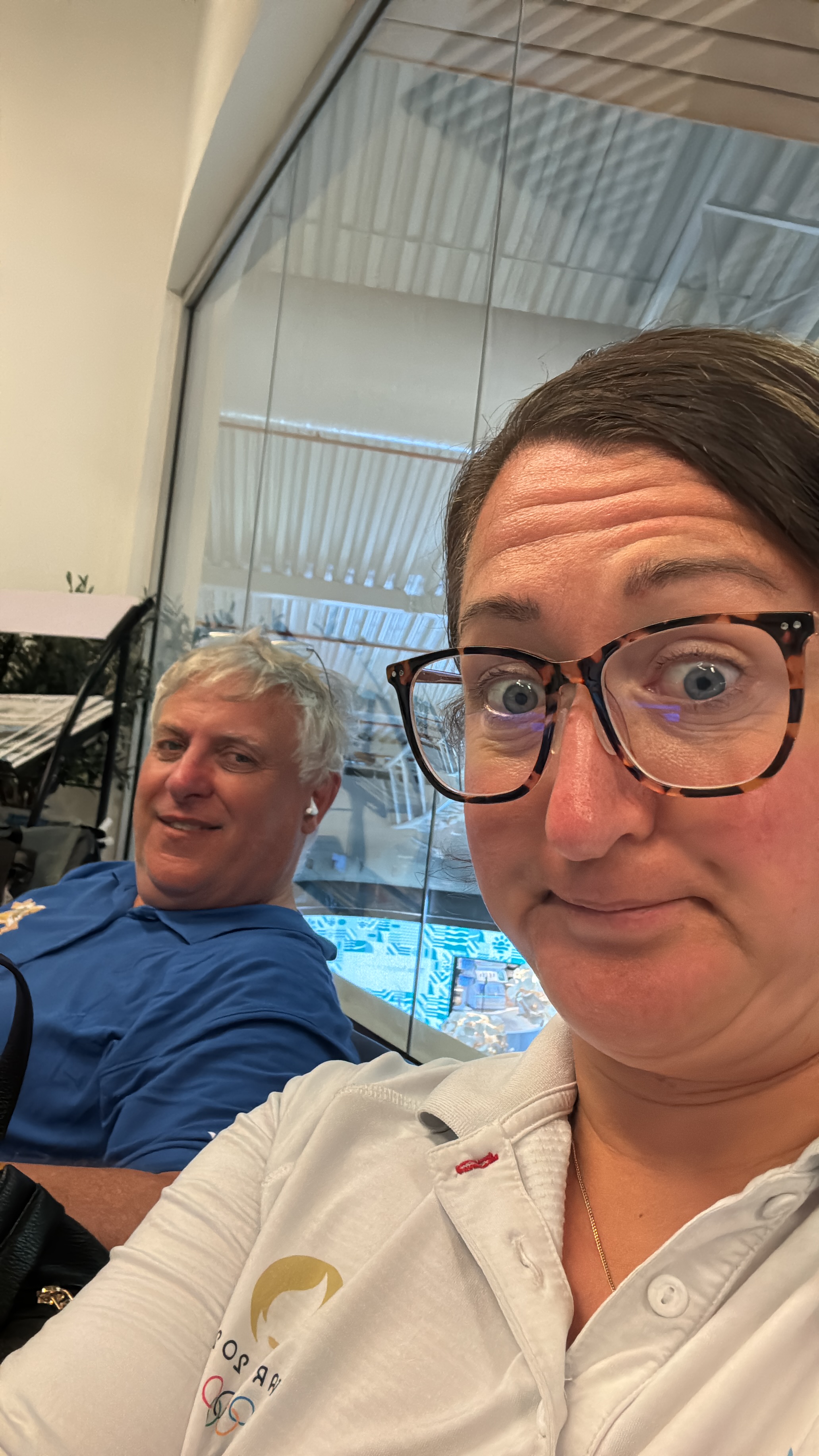
The aviation gods intervene
My original travel plan was offensively civilised: British Airways from Faro to Gatwick, Club Europe, lounge, dinner, home.
Before anyone imagines World Sailing routinely dispatches me around Europe in Business Class, it does not. I had used my own, hard-earned collection of points and a reward flight to treat myself to a slightly more civilised journey home. Years of airports had finally paid off. I had a proper seat, lounge access and possibly even a glass of something nice ahead of me.
I was feeling quite pleased with myself.
This was hubris.
The UK air traffic control system had other ideas, and Faro’s departure boards gradually became works of speculative fiction. Flights moved, delayed, moved again and disappeared. Still, we persevered.
Club Europe at least gave me lounge access. Stoggs did not technically have lounge access, but in one of those ridiculous coincidences that only seems to happen in sailing, an ILCA sailor happened to be working at the desk.
This is why networking matters. Forget LinkedIn. The real professional network is knowing a sailor at exactly the moment you need to smuggle a race officer into an airport lounge.
Stoggs’ Ryanair flight to Manchester was scheduled for 19:50. It eventually left at around 22:40 and deposited him home at approximately 3am. Given what had happened to him in Bangalore the previous week, we regarded this as an overwhelming victory.
Stoggs had escaped.
I had not.
British Airways would like me to visit Lisbon
Eventually, my flight stopped being a meaningful concept and British Airways produced an alternative.
Instead of flying directly from Faro to Gatwick, I could remain in Portugal until the following evening, fly from Faro to Lisbon at 18:10, spend another night in the travelling abyss, and then fly from Lisbon to Gatwick at 11:15 the day after that.
An inspired solution, particularly given that I was already in Faro and Gatwick is, famously, not in Lisbon.
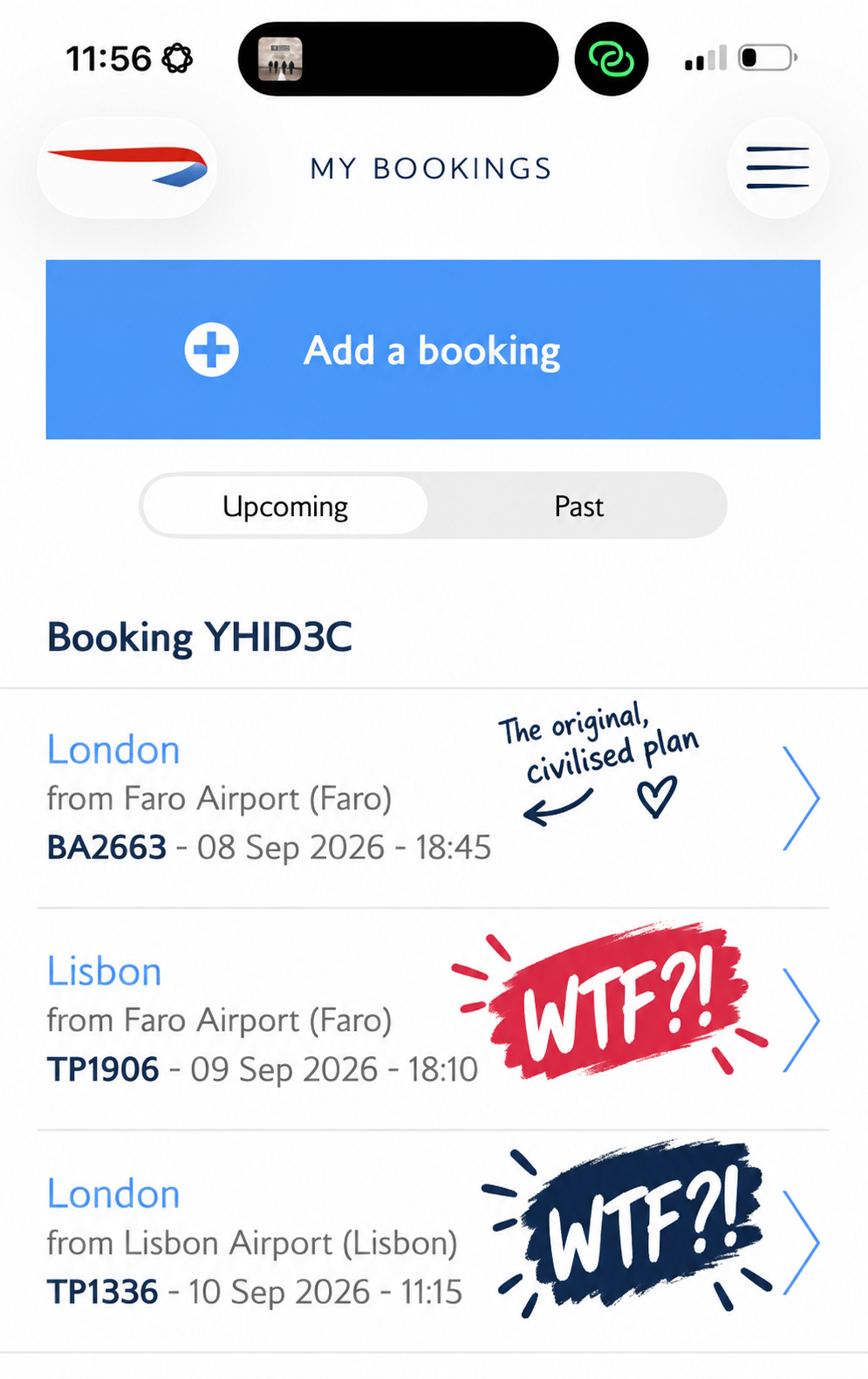
I tried calling BA. Again. And again. And again. By the end of the evening I had attempted to contact them approximately fourteen times. At one point I resorted to the virtual assistant and explained that I was a disabled passenger, stranded in Portugal, without accommodation.
The virtual assistant suggested I ask at the airport.
Excellent.
Technology really is transforming our lives.
By this point Fiona had authorised me to get home by any reasonable means. Possibly any means. The distinction was becoming academic. I briefly considered commandeering a Hansa 303 and sailing home, but unfortunately there weren’t enough charter boats.
So I booked an easyJet flight for the following morning and found somewhere to sleep.
“Hotel” may be generous. It had a bed, it had walls, and most of those walls appeared committed to remaining upright. At this point my requirements had become fairly modest. An emergency Aldi expedition provided dinner, and a few hours later I was back at Faro Airport.
By 5:37am I was sweating biscuits and drinking an unexpectedly excellent iced latte. And because the universe understands comic timing, this was also roughly when work budget drama arrived on my phone.
There are moments when you have to appreciate the composition. I was stranded in Portugal. My lovingly acquired reward flight had vanished. I’d slept in a questionable hotel. I was operating on fumes. I was attempting to board an emergency easyJet extraction flight.
And Finance wanted a chat.
I love my job.
Airport Drama: Day Two
The easyJet flight was beautifully simple: Faro to Gatwick. One aircraft. Two airports. No Lisbon. No overnight connection. At this point I considered this level of ambition reckless.
Then I looked at the departure board.
LUTON — CANCELLED.
I cannot adequately describe the physical response my body now has to the word “cancelled”. It is somewhere between fight-or-flight and being pursued through woodland by a large predator.
Fortunately, the Gatwick flight remained stubbornly present. Then the crew appeared. Then an actual aircraft appeared. My standards had fallen so far that I regarded both of these developments as thrilling.
I used airport assistance for boarding. I should point out that I am a four-time Paralympian, travel constantly and am perfectly capable of getting myself onto an aeroplane with one arm. But I had already watched my lovingly acquired reward flight disappear into the Portuguese night, and if anyone thought I was now going to politely decline the opportunity for early boarding while approximately 180 people prepared for ritual combat over easyJet overhead storage, they had fundamentally misunderstood both disability inclusion and competitive sport.
There are times to demonstrate independence. There are times to protect accessibility.
And there are times to get your bag in the bloody overhead locker.
My bag ended up three rows behind me anyway.
I love my job.
Then something extraordinary happened. The doors closed. The aircraft moved. And, against all available evidence regarding my recent relationship with aviation, it took off.
Portugal became smaller beneath me.
I had escaped.
Unfortunately, WSIC can apparently find me anywhere
Gatwick began Phase Two: North Terminal, shuttle, South Terminal, railway station, train towards Victoria, off at Clapham Junction, find the Southampton train.
By this point I had been travelling for long enough that Clapham Junction felt like a meaningful homecoming.
I found the train. I sat down. Southampton was on the horizon. The dogs were getting closer. I began to believe that perhaps the international incident was finally over.
This was adorable.
My phone buzzed. Trinidad and Tobago. Then Challenger. Then charter boats.
Of course it was charter boats.
There is something particularly impressive about successfully escaping a foreign country after the collapse of your travel arrangements, crossing Gatwick, navigating Clapham Junction and finally boarding the train home, only to discover that the World Sailing Inclusion Championships can apparently track your precise location through WhatsApp.
I answered the things that actually needed me. Then, somewhere around Clapham Junction, through the fog of sleep deprivation, I remembered something extremely important.
I have an assistant.
Leo.
Excellent.
Some messages went to Leo. Challenger was introduced directly to Luis. Responsibilities began migrating away from my phone at a deeply satisfying rate.
This wasn’t abandonment. This was delegation.
And frankly, after Bangalore, Leo had already demonstrated considerably greater powers of survival than any of us had previously appreciated.
Luis, meanwhile, was about to become much better acquainted with Challenger.
Everybody was growing professionally.
I was going home.
The timing is probably appropriate, because our host now has only a few weeks before sailors, coaches, officials and equipment begin arriving and the theoretical championship we’ve spent months discussing becomes a very real one.
This is the point where planning becomes delivery. There is no more “later”.
The monster is at the gates.
And annoyingly, I really do love it
It’s easy to describe all of this as chaos because, frankly, quite a lot of it is.
But underneath the charter spreadsheets, unanswered emails, insurance questions, classification schedules, transport plans and my deteriorating relationship with British Airways is something rather brilliant.
We have created a championship people want to attend.
We have nations entering because development programmes gave them a pathway into international competition. We have athletes travelling across continents because there is now somewhere worth travelling to. We have new disciplines developing and existing fleets growing. We have sailors desperately trying to find charter boats because so many of them want to race that we don’t currently have enough equipment.
Fifty-six entries and fourteen available charter boats is an operational nightmare.
It is also demand.
That’s the uncomfortable thing about growth: eventually success stops looking neat. It turns up disguised as spreadsheets, equipment shortages, overflowing inboxes and increasingly urgent conversations about containers.
WSIC has grown beyond the point where goodwill and heroic last-minute problem solving can carry it. It needs serious delivery now. Everyone involved needs to understand the scale of what is coming and work at the speed the championship requires.
Because the sailors have already done their part. They entered. They trained. They found funding. Some came through our development programmes to reach this point. Some are travelling halfway around the world.
Our job is to make sure there is a championship worthy of that effort waiting for them when they arrive.
So yes, WSIC is a monster.
But it is a monster I am immensely proud of creating.
Now we just have to feed it.
Preferably with approximately twenty-one Hansa 303s.
Somewhere on the train to Southampton, my phone buzzed again. I looked at it.
Charter boats.
Obviously.
I sent it in the appropriate direction, looked out of the window and repeated the phrase that had somehow carried me through Bangalore, Portugal, British Airways, fourteen unanswered calls, a questionable hotel, easyJet, Gatwick and the British railway network.
I love my job.
And, annoyingly, I really do.


Leave a Reply